Invoice or receipt? The documents a service sends and why
Services send several kinds of billing documents, and the names are used loosely. Knowing the difference between an invoice, a receipt and a credit note tells you what you owe, what you paid and what you got back.
ReloadableVCC Team 3 min read
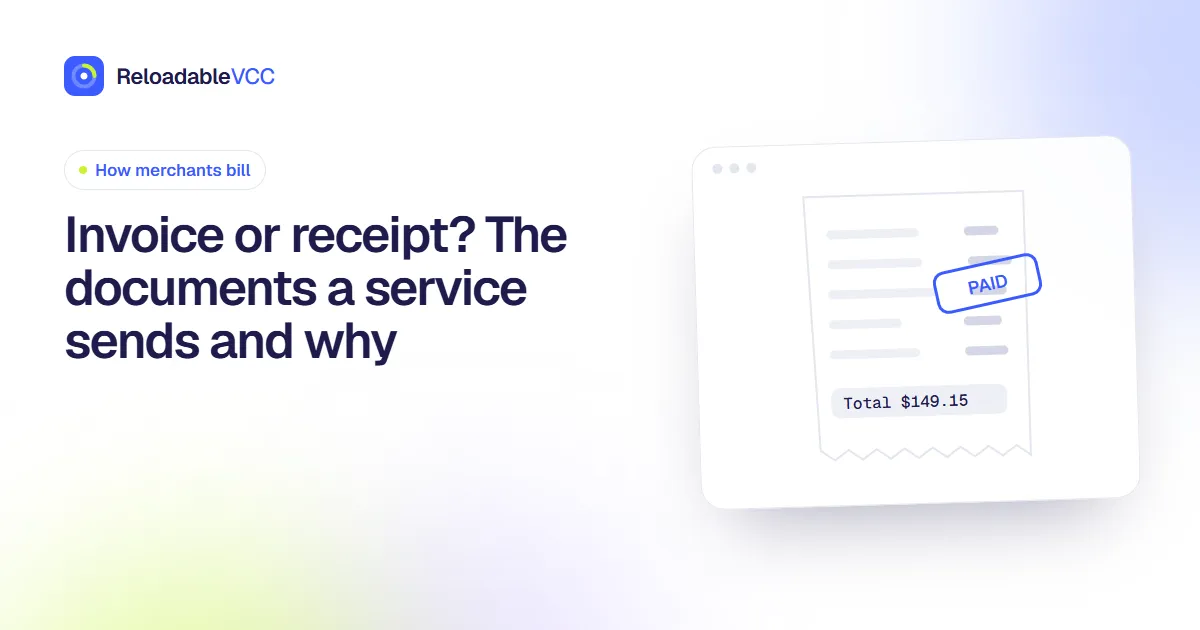
A service you pay for will send you a mix of documents over time: invoices, receipts, credit notes, sometimes statements. They often look similar and the names are used inconsistently. Here is what each one normally means.
Invoice
An invoice is a request for payment. It lists what you are being charged for, the amounts, any tax and a due date. For card subscriptions, the invoice is often issued and paid in the same moment, so you may see an invoice marked "paid" straight away.
An unpaid invoice means money is still owed. If you see one in a billing portal with a status such as "open" or "past due", a payment has probably failed. See dunning, explained.
Receipt
A receipt confirms that a payment was made. It shows the amount, the date, the payment method (usually the last four digits of the card) and what it was for.
This is the document to keep as proof of payment.
Credit note
A credit note reduces what you owe. You may receive one when:
- you downgrade mid-period and the service credits the difference;
- a charge is partly refunded;
- an invoice was issued with an error.
A credit note does not always mean money goes back to your card. Often it becomes account credit used against the next invoice. Read it to see which.
Refund confirmation
When money does go back to the card, you normally get a refund confirmation with the amount and date. Refunds to a card can take several days to appear, depending on the card network and the merchant.
Statement
Some services send a monthly summary of all charges, payments and credits. It is useful for an overview but is not itself a receipt.
Which to keep
| Document | Keep? | Why |
|---|---|---|
| Receipt | Yes | Proof of payment |
| Paid invoice | Yes, if it shows details the receipt lacks | Tax and line items |
| Credit note | Yes | Proof of credit or refund |
| Refund confirmation | Yes | Proof money was returned |
| Unpaid invoice | Until resolved | Shows an outstanding amount |
| Statement | Optional | Overview |
Where to find them later
Billing pages usually list past documents, frequently as PDF downloads. Some only email them. To avoid hunting later:
- download receipts for yearly plans and large purchases when they arrive;
- keep them in one folder named by service and year;
- consider a separate email address for billing, as described in a billing inbox.
Business details on invoices
Business buyers should enter the company name and tax ID in billing settings ahead of the next charge. Many services cannot reissue past invoices with new details.
Frequently asked questions
The service only shows invoices, not receipts. Is that enough?
An invoice marked "paid", with the date and the payment method, works as proof of payment for most purposes.
Can a service change an invoice after it is issued?
It usually issues a credit note and a new invoice instead of editing the original. Keep both.
How long should I keep receipts?
For personal subscriptions, until any return or dispute window has passed. For business costs, as long as your local accounting rules require.
Summary
An invoice asks for payment, a receipt proves it, a credit note reduces what you owe and a refund confirmation shows money returned. Keep receipts, credit notes and refund confirmations, and add business details before the next invoice is issued.
- #invoices
- #receipts
- #records